



About
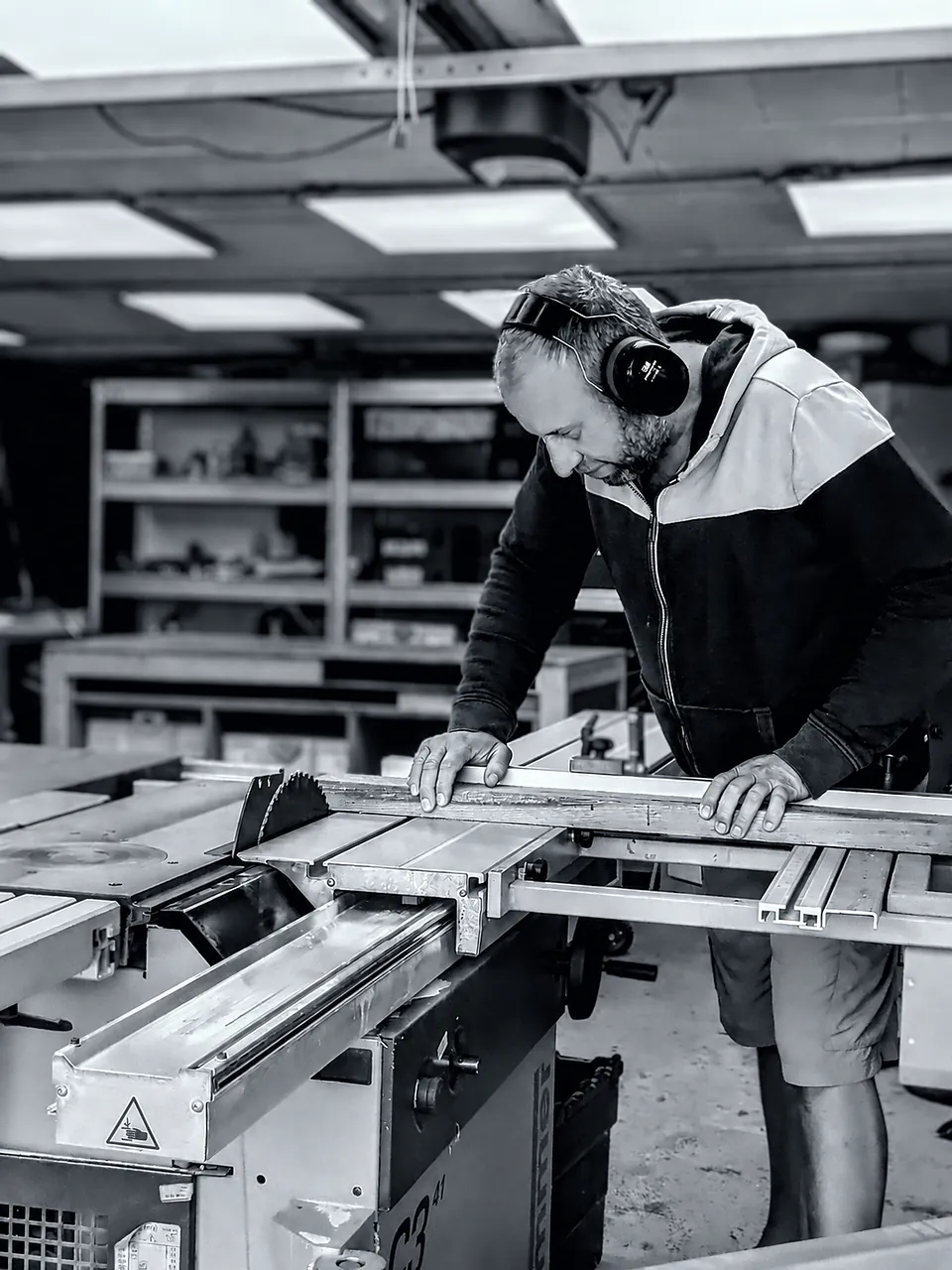
Behind LPBB there is, first of all, a joiner.
My name is Yann and I have been working with wood for several years.
With Les P'tits Bouts d'Bois I wanted to create a workshop where I could go further than traditional joinery: choose timbers for their character, experiment with assemblies, develop my own patterns and make pieces you do not find everywhere.
Every piece passes through my hands, from rough timber to the finish.
Recognition that means something
Behind LPBB, there is above all a passion for wood, a taste for work done properly and the desire to create pieces with a soul. Being officially recognised as an Artisan d’Art today is a real source of pride, and a fine acknowledgement of the work, the high standards and the creativity I put into every piece. A distinction that encourages me to carry on with this adventure, giving each species of wood the chance to reveal its character.

Timbers chosen for their character
Black walnut, maple, purpleheart, padauk, oak, ash, beech, cherry... Each timber has its own colour, grain, properties and origin.
I do not try to work exclusively with woods from a single place. I choose timbers for what they can bring to a piece: a contrast, a warmth, a depth or simply a particular character. Where relevant, their origin is given. A variation in colour or grain is not a defect.
That is the wood. And that is precisely what makes every piece different.
Made in my workshop in Alsace
LPBB pieces are made by hand in my workshop in Alsace. There is no production line and no industrial series.
Some pieces are relatively simple. Others take several days of work and a succession of operations before the final pattern even appears.
From rough timber to finished piece
On Création and Signature pieces the pattern is built into the thickness of the wood: intermediate panels, successive cuts and re-compositions follow one another before the drawing appears.
Patterns that are neither printed nor stained
The colours in the creations are those of the timbers used. The contrasts, lines and shapes come from assembling solid wood, its orientations and the various re-cuts made in the workshop.
The pattern is not added to the wood: it is made with it.
Taking the time to do it properly
Cutting, gluing, drying times, calibrating, sanding and finishing cannot always be rushed. I would rather make fewer pieces and keep control of every step than chase quantity.
Objects made to live with
A board must be able to cut. A butcher's block must be able to work. A table must be able to live.
A beautiful piece is not meant to become fragile just because it is good-looking. I look for that balance between function, material and aesthetics.
The making steps
- Choosing the timbers →
- Cutting →
- Planing and calibrating →
- Preparing the parts →
- Assembly →
- Gluing →
- Re-cutting →
- Re-composition →
- Sanding →
- Finishing →
- Final check
Every piece of wood is different. Every piece I make is too. That idea sums up LPBB best: start from a natural material, respect its character and give it a form that will find its place in someone's home.
LPBB — One wood, one character. Yours.